Category | AI And ML
Last Updated On 08/10/2026
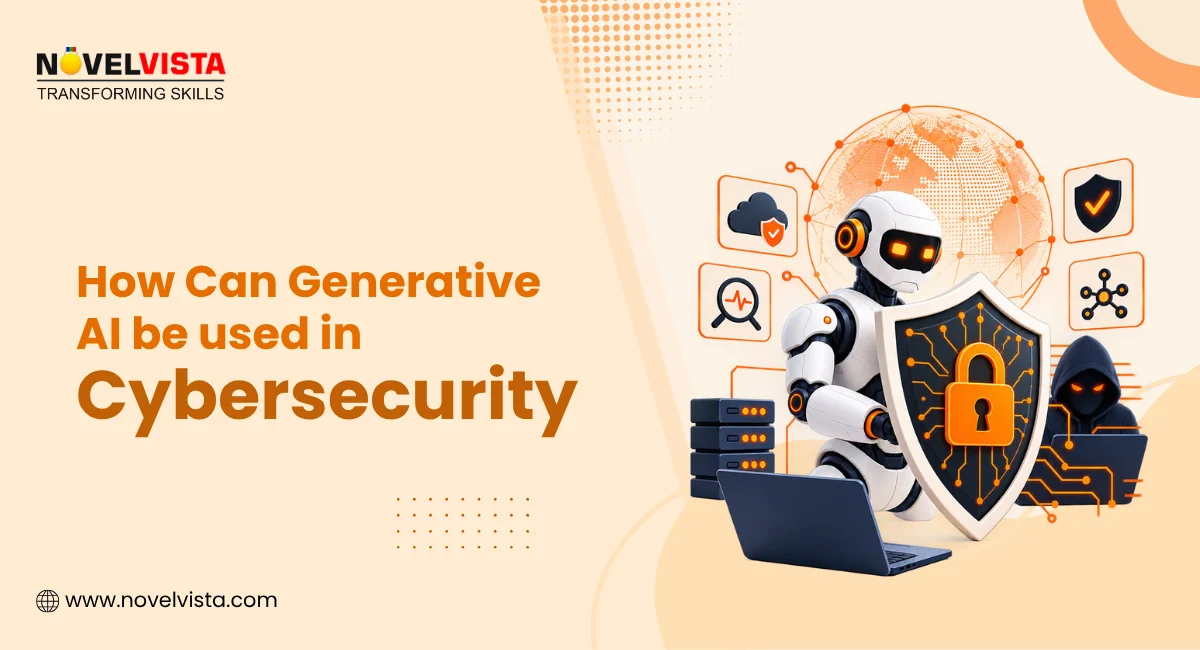
Cybersecurity teams are dealing with a difficult reality: threats are becoming faster, more sophisticated, and harder to investigate manually. At the same time, security teams are expected to analyze enormous volumes of alerts, logs, vulnerabilities, emails, and threat intelligence every day.
So, how can generative AI be used in cybersecurity?
The answer goes beyond simply asking an AI chatbot to write a security report. Generative AI can help security professionals analyze security data, investigate incidents, summarize threat intelligence, generate detection rules, support vulnerability management, and accelerate incident response.
NIST's emerging Cyber AI Profile specifically identifies AI-enabled cyber defense as one of its three major focus areas, alongside securing AI systems and thwarting AI-enabled attacks.
But how does this actually work? What are the practical applications? And can AI replace cybersecurity professionals?
Let's explore.
Generative AI can be used as a security assistant that helps cybersecurity professionals understand large amounts of information and respond to threats faster.
Unlike traditional automation, which usually follows predefined rules, generative AI can work with unstructured information such as security reports, incident notes, vulnerability descriptions, logs, code, and threat intelligence.
Some of the most important applications include:
| Cybersecurity Area | How Generative AI Helps |
|---|---|
| Threat detection | Analyzes security signals and identifies suspicious patterns |
| Incident response | Summarizes incidents and recommends response actions |
| Threat intelligence | Converts large reports into actionable insights |
| Vulnerability management | Explains vulnerabilities and prioritizes remediation |
| Phishing detection | Analyzes suspicious messages and explains potential risks |
| Security operations | Reduces repetitive investigation and documentation |
| Security awareness | Creates realistic training scenarios and simulations |
| Security reporting | Generates incident summaries and compliance reports |
This explains how AI can be used in cybersecurity across different stages of the security lifecycle.
One of the biggest challenges for a Security Operations Center (SOC) is alert overload.
Security platforms can generate thousands of alerts, but not every alert represents a genuine threat. Security analysts therefore need to investigate, correlate, prioritize, and classify these signals.
Generative AI can assist by bringing information from multiple sources together.
For example, imagine an employee's account suddenly logs in from an unusual location. Around the same time, multiple failed login attempts occur, followed by access to sensitive files.
Instead of presenting analysts with several disconnected alerts, an AI-powered security system can summarize the activity and highlight the relationship between the events.
It could help answer:
This doesn't eliminate the need for a security analyst. Instead, it can reduce the time spent manually connecting information.
Incident response often involves pressure, uncertainty, and large amounts of information.
When a security incident occurs, teams may need to review logs, investigate affected systems, identify indicators of compromise, understand the attack timeline, and document their actions.
Generative AI can support several of these activities.
For example, it can take technical incident information and create a simplified timeline:
Initial access → suspicious activity → privilege escalation → lateral movement → data access → containment
It can also summarize technical findings for different audiences.
A SOC analyst may need detailed technical information, while a senior executive may need to know:
This ability to transform technical information into understandable summaries is one of the practical answers to how is AI used in cybersecurity.
NIST's Cyber AI Profile similarly highlights opportunities to use AI to enhance cybersecurity processes while recognizing the challenges associated with AI-supported defensive operations.
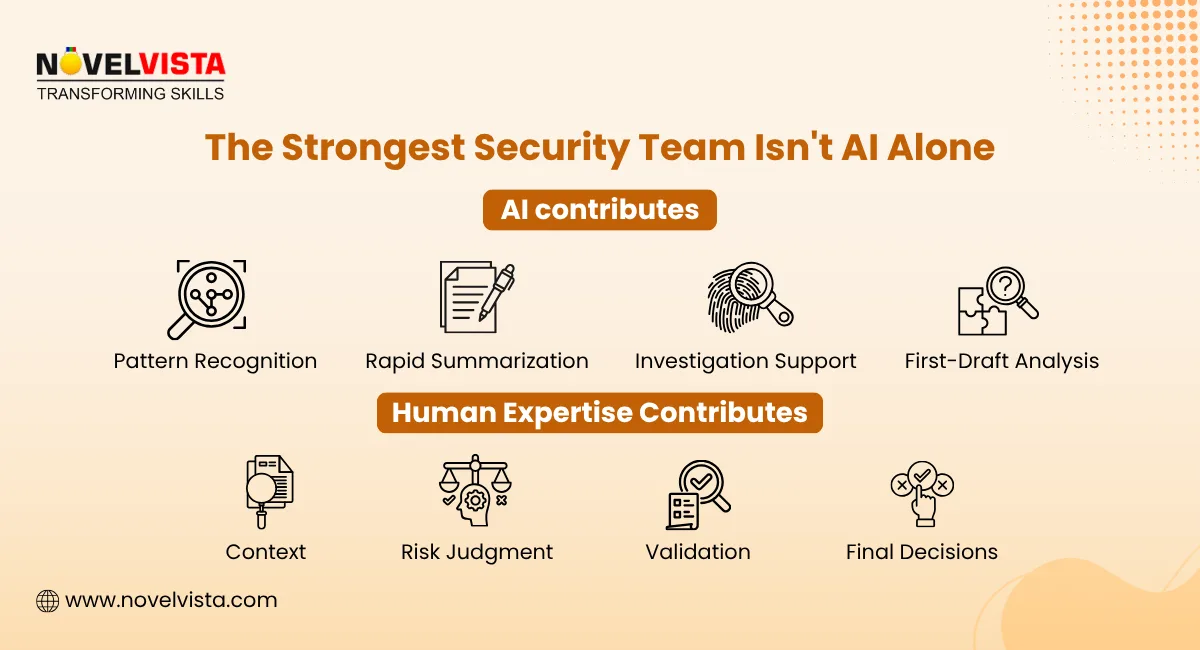
Cybersecurity teams constantly consume threat intelligence from security vendors, government agencies, research organizations, vulnerability databases, and industry reports.
The problem is not necessarily a lack of information. It is the sheer volume of information.
Generative AI can help security professionals:
For example, instead of reading a 30-page threat report from beginning to end, an analyst could use an AI system to identify the key threat actors, tactics, affected technologies, indicators, and recommended defensive actions.
Human analysts can then validate those findings before using them operationally.
Vulnerability management is another important area where AI can assist cybersecurity teams.
Organizations may have thousands of vulnerabilities across applications, endpoints, cloud environments, and infrastructure. The difficult question is not simply:
"Which vulnerabilities exist?"
It is:
"Which vulnerabilities should we address first?"
Generative AI can help explain vulnerability information in plain language and connect technical findings with potential business impact.
For example, an AI system could help summarize:
| Information | AI-Assisted Output |
|---|---|
| CVE details | Simple explanation of the vulnerability |
| Affected system | Identify potentially exposed assets |
| Exploit information | Explain known exploitation risks |
| Business context | Connect vulnerability to critical systems |
| Remediation | Suggest possible mitigation steps |
However, AI-generated recommendations should be reviewed against trusted vulnerability intelligence and organizational risk policies.
Phishing attacks remain a major security concern because attackers continually modify their messages to appear legitimate.
Generative AI can analyze the language, context, links, sender information, and other characteristics of suspicious communications.
It can help identify warning signs such as:
It can also explain why an email appears suspicious.
That explanation is important because cybersecurity awareness is not only about blocking attacks. It is also about helping employees recognize future attacks.
The modern SOC involves much more than threat detection.
Security professionals also spend significant time documenting incidents, writing reports, creating investigation notes, updating tickets, and communicating with other teams.
Generative AI can automate or accelerate many of these repetitive tasks.
For example, after an investigation, AI can help create a first draft of an incident report containing:
The analyst can then review and correct the output.
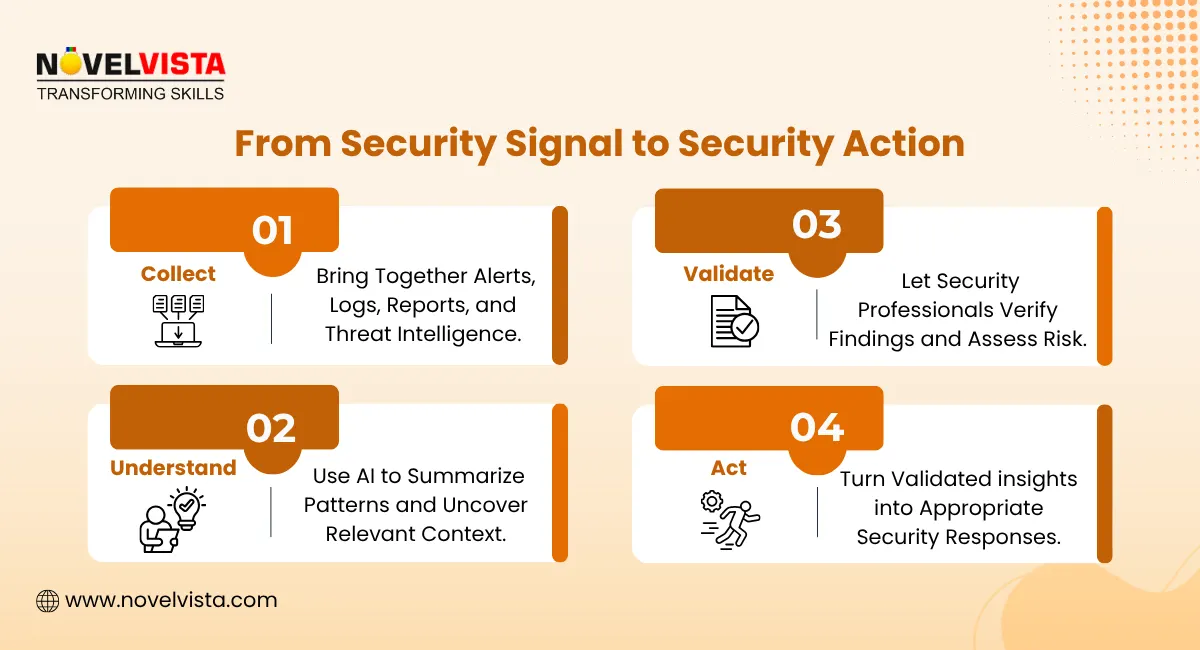
This is an important distinction:
AI can accelerate cybersecurity work without removing human accountability.
There is an important catch.
Organizations cannot simply introduce a generative AI tool into their security environment and assume that the technology is automatically safe.
Generative AI itself introduces risks, including:
NIST's Generative AI Profile identifies risks that are novel to or intensified by generative AI and provides actions for managing those risks across the AI lifecycle.
This means organizations need appropriate governance, access controls, data protection, human oversight, testing, and monitoring.
A useful approach is to divide cybersecurity activities into three levels:
| Activity | Appropriate AI Role |
|---|---|
| Data analysis | Strong AI assistance |
| Incident summarization | Strong AI assistance |
| Threat intelligence analysis | AI + human validation |
| Remediation recommendations | AI recommendation + expert approval |
| Critical security decisions | Human accountability |
The more consequential the decision, the more important human review becomes.
AI adoption should fit into an organization's broader cybersecurity strategy rather than operate separately.
NIST CSF 2.0 provides a structured approach around cybersecurity risk management, while NIST is developing additional guidance specifically around the intersection of AI and cybersecurity.
The emerging Cyber AI Profile focuses on three areas:
Secure: Protect AI systems and their components.
Defend: Use AI to improve cybersecurity capabilities.
Thwart: Address AI-enabled attacks and emerging threat vectors.
This provides a useful way for organizations to think about AI adoption from both sides: using AI for cybersecurity and securing AI itself.
When implemented responsibly, generative AI can provide several benefits.
AI can quickly summarize large volumes of security information, helping analysts focus on important findings.
Routine reporting, documentation, summarization, and repetitive analysis can be accelerated.
Complex technical information can be converted into simpler explanations for analysts, managers, and business stakeholders.
Security professionals can spend more time on investigation, decision-making, and strategic security work.
AI can explain unfamiliar vulnerabilities, attack techniques, and security concepts, helping professionals understand new threats faster.
Despite its potential, generative AI is not a perfect cybersecurity solution.
AI can generate incorrect answers. It may misunderstand context or recommend an inappropriate response. It can also introduce security risks if sensitive information is provided to an improperly configured system.
Therefore, organizations should establish clear controls around:
The goal should not be "replace cybersecurity experts with AI."
The better goal is:
"Help cybersecurity experts work faster, understand more, and respond better."
The relationship between AI and cybersecurity will continue to evolve.
Organizations will increasingly need professionals who understand both cybersecurity fundamentals and AI capabilities. This includes knowledge of generative AI, large language models, AI security risks, threat detection, incident response, governance, and responsible AI.
NIST's work on its Cyber AI Profile reflects this broader shift. The framework is designed to help organizations secure AI systems, use AI for cyber defense, and address AI-enabled attacks.
The future therefore isn't simply about asking how generative AI can be used in cybersecurity.
The bigger question is:
How can organizations integrate AI into cybersecurity while maintaining security, accuracy, governance, and human oversight?
Organizations that answer that question thoughtfully can use AI to improve security operations without treating AI as a replacement for cybersecurity expertise.

So, how can generative AI be used in cybersecurity? It can support threat detection, incident response, threat intelligence, vulnerability management, phishing analysis, security reporting, and SOC operations. It can reduce repetitive work and help cybersecurity professionals process complex information faster.
However, effective use of AI in cybersecurity requires more than simply adopting an AI tool. Organizations need strong governance, data protection, human oversight, continuous evaluation, and the right security controls to ensure AI is used responsibly.
As AI becomes more deeply integrated into business and technology environments, cybersecurity professionals who understand how AI is used in cybersecurity will be better positioned to identify emerging threats, strengthen security operations, and build more resilient systems. For professionals looking to develop these skills, NovelVista's Generative AI in Cybersecurity course offers a practical way to explore how generative AI can be applied to modern cybersecurity challenges.
Generative AI can help with threat detection, incident response, vulnerability analysis, phishing detection, threat intelligence, and security reporting.
AI can analyze security data, identify suspicious patterns, summarize incidents, prioritize threats, and support cybersecurity professionals with faster analysis.
AI is used to assist SOC teams with alert analysis, threat investigation, incident documentation, threat intelligence, and security monitoring.
The use of AI in cyber security includes improving detection, reducing repetitive tasks, accelerating investigations, and helping teams respond to threats more efficiently.
No. Generative AI can support cybersecurity teams, but human expertise is still essential for validation, risk assessment, critical decisions, and incident response.
Author Details

Confused About Certification?
Get Free Consultation Call
Stay ahead of the curve by tapping into the latest emerging trends and transforming your subscription into a powerful resource. Maximize every feature, unlock exclusive benefits, and ensure you're always one step ahead in your journey to success.